Clear expectations for independent tutors
Cancellation And No-Show Policy For Private Tutors
A practical policy helps the tutor and student understand what happens when a lesson is cancelled, missed or moved. Decide the outcomes in advance, communicate them clearly and record each case by lesson.
Why cancellation policies matter for private tutors
A cancelled lesson affects more than one calendar slot. The tutor may have reserved preparation time, declined another booking or expected the lesson to be part of the week's income. The student also needs to know whether the lesson can move and whether payment is still expected.
Without a policy, each cancellation becomes a new negotiation. Similar cases may be handled differently, payment follow-up feels personal and the calendar no longer explains what happened.
A useful policy is short, understandable and applied consistently. It defines the normal outcome while leaving a deliberate way to record an exception.
Use clear lesson outcomes
Describe what happened to the lesson before deciding what happened to payment. These six outcomes cover most private-tutor scheduling situations.
The lesson happened. Record teaching follow-up and the applicable payment state.
The lesson did not happen and no charge is expected.
The lesson did not happen but remains chargeable under the agreed policy.
The student did not attend and gave no usable notice. Apply the agreed payment rule separately.
The tutor did not attend. Record the outcome and the remedy promised to the student.
The original occurrence remains in history and is linked to a replacement lesson.
Lesson outcome and payment state are separate. For example, a cancelled paid lesson can still be unpaid until money is received, while a cancelled free lesson has a no-charge payment state.
Decide what is charged and what is not
Write down the decision points before sharing the policy. Do not rely on phrases such as “reasonable notice” unless the tutor and student have the same understanding of what that means.
Choose rules that the tutor can actually apply and explain. Keep lesson price snapshotted on each occurrence so future rate changes do not rewrite older cancellations.
Communicate the policy before problems happen
Share the policy before the first paid lesson or when a continuing student agrees to an updated version. Keep it in a place the student or payer can find later, and ask them to confirm that they have read it.
- 1
Share
Send the same written policy to every student or payer.
- 2
Confirm
Record when the current version was acknowledged.
- 3
Apply
Use the agreed outcome and note any deliberate exception.
If the policy changes, state when the new version begins. Do not silently apply a new cancellation rule to an older lesson.
Keep records by lesson
Every cancellation, no-show and reschedule should remain attached to the affected lesson occurrence. Record the original date, outcome, price snapshot, payment state and a short factual note when needed.
Original lesson
Wednesday · 17:00
Outcome: rescheduled
Replacement lesson
Friday · 16:30
Linked to the original occurrence
The guide to managing recurring tutoring lessons explains how schedule rules and individual occurrences preserve this history.
Avoid vague payment follow-up
A reminder should refer to the lesson date, agreed outcome and amount due. Avoid emotional language, assumptions or long copies of the cancellation conversation.
Clear and factual
Payment for the cancelled lesson on 14 August remains due under the agreed cancellation policy.
Too vague
Please remember the lesson payment we discussed earlier.
Use the private tutor payment tracker to keep outcome, amount and payment state connected. The guide on tracking private tutor payments adds the after-lesson and weekly follow-up routine.
A simple cancellation and no-show policy template
This template is not legal advice. It is an operational example for organizing tutoring expectations. Adapt it to your service, agreement and applicable requirements, and seek qualified advice where needed.
Lesson cancellation policy
Fill in the choices before sharing
- Notice
- Cancellations received at least [notice period] before the lesson are [free / eligible for rescheduling].
- Late cancellation
- Cancellations received later than this are [charged in full / partially charged / no charge].
- Student no-show
- If the student does not attend and gives no notice, the lesson is [charged / handled as follows].
- Tutor cancellation
- If the tutor cancels, the lesson will be [rescheduled / handled as follows].
- Rescheduling
- A replacement time is confirmed only when both tutor and student agree to the new date.
- Contact
- Cancellation requests should be sent through [agreed channel].
- Effective date
- This policy applies from [date] and was shared on [date].
How Clasenda tracks lesson status and payment state
Clasenda keeps the lesson outcome separate from its payment state. A tutor can mark a cancellation as free or paid, preserve a rescheduled occurrence and keep the original lesson price in history.
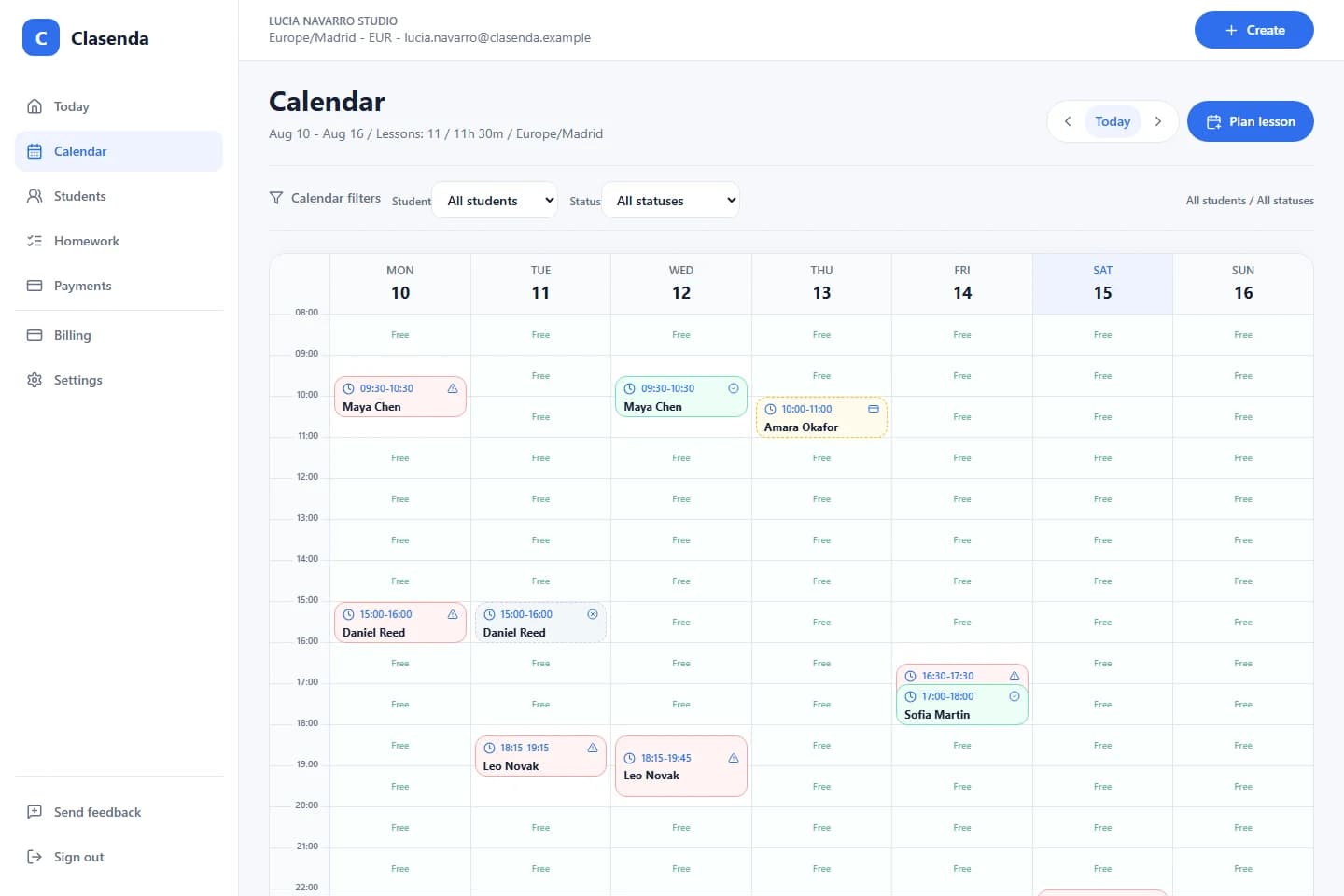
The purpose is a factual record: what happened, what the agreed policy required and whether the resulting amount has been paid.
Keep every outcome explainable
Track lesson outcomes and payment state in Clasenda.
Start with one upcoming lesson and the policy you already use. Record the outcome and payment state separately when plans change.
Start with one lesson